


27 Jun Think Like a Scientist: A Guide to the Scientific Method
TL;DR: The scientific method is a multi-step process used to explore questions and find answers. In this post, we explain 8 important steps to the scientific method and provide a real-life example on how it is used in SLC13A5 research.
Using the scientific method, while studying the SLC13A5 gene, the Kurrasch lab asked two questions, conducted background research, formed a hypothesis, conducted experiments, collected and analyzed data, and shared their conclusions in a peer-reviewed publication. This work is an important step in understanding SLC13A5 Epilepsy and improving the lives of those impacted by the disorder.
In our last blog, “How do scientists ask questions?”, you found out what a hypothesis is, what you include in one, and the different types. But when do you actually make and use one? A hypothesis is actually one part of a larger process called the scientific method: a methodical way to answer questions. This process is used across different fields of study when trying to solve an unknown mystery and is known as a series of steps that starts with asking a question and ends with finding an answer.
The scientific method consists of the following eight important steps:
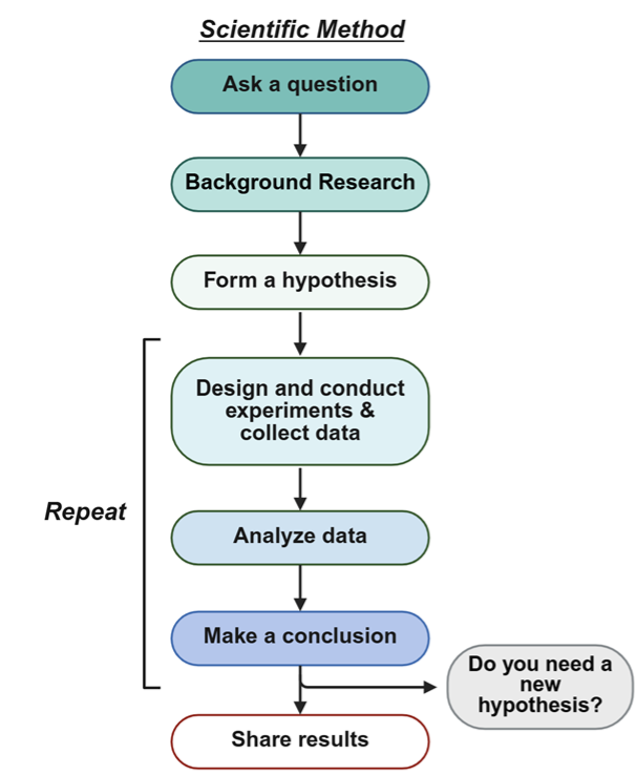
- Ask a question: Many times studies start by making an observation that we do not understand or finding a gap of knowledge that has not been solved. This is exciting! It means you now have something to research!
- Background research: It is important to understand what you are going to study. What led you to your question? What has already been discovered? This research is important for knowing what has already been found and what needs to be done next. Use resources available to you, whether it is from your local library or credited internet sources. Scientists do this by reading scientific, peer-reviewed literature. Check out how to read a paper from our previous blog post here.
- Form a hypothesis: Based on the first two steps, what is a possible explanation or answer to your question/observation? Make sure it is testable no matter the outcome. This will direct all of your future studies.
- Design and conduct experiments & collect data: When written well, your hypothesis will lead you to testable experiments. When figuring out what to do, always ask if it directly tests the hypothesis and question you are asking. Remember to take note of everything happening during experimentation. This is important for repeating the experiments and collecting all data.
- Analysis: Although doing experiments can be a lot of fun, the data collected needs to be examined so we can understand the results. This can be anything from counting the number of cells and putting it in a graph to comparing and contrasting what proteins in different cells look like.
- Make a conclusion: It’s time to interpret the results from the completed and analyzed experiments. Was your hypothesis supported or not? Did you find something new that you weren’t even looking for? No matter what, anything found is something new and exciting that pushes the scientific field forward!
- Repeat: All well-done studies should be completed multiple times to make sure the most accurate answer is found. Sometimes outside variables can affect the outcomes of our experiments and that’s okay! This is why we try to be unbiased in our experiments, have proper controls, and repeat them when we can. It is also important to make sure that your experiments are repeatable, or done in the same way, by other scientists so that the results can be trusted. So take good notes and do your experiments the same way every time. This is also when you can ask yourself if you need to redo the experiments with a new hypothesis in mind.
- Share what you find: Communicating findings, whether it’s in a scientific journal or at the local science fair, is the best way for advancing our scientific knowledge. When you started your project, you had to do your background research to see what is already known. Once complete, your work will be added to this pool of knowledge to inform future projects, enhance collaboration, and it provides opportunity for feedback to better the work as a whole.
Example of how the scientific method is used for studying SLC13A5:

The scientific method is used in all major studies including those trying to understand SLC13A5. Recent work from the Kurrasch lab asked the two questions:
- What phenotypes or observable characteristics occur because of the loss of the SLC13A5 gene and
- What is the molecular mechanism or process that leads from the loss to the disorder?
To answer this question the researchers needed to conduct background research. This includes:
- Understanding that the SLC13A5 gene codes for a protein that is a citrate transporter in cells in the brain, liver, and bone as examples.
- Citrate is a molecule that plays an important role in how our cells make and use energy.
- Defects in the transporter can lead to many symptoms including frequent and prolonged seizures starting early in life.
- However, it isn’t fully understood how defects lead to these symptoms.
The authors hypothesize that:
- When SLC13A5 transporter doesn’t work properly, this leads to extra citrate outside of the cell that binds other ions important for cell signaling, causing seizures.
To conduct experiments that test this hypothesis, the researchers decide to:
- Create a model to learn about SLC13A5 Epilepsy. They use zebrafish to create mutations in the SLC13a5a/b genes that prevent the transporter from working properly and observe any changes to normal behavior. Zebrafish have two copies of SLC13A5 so they had to change both copies to make this model.
- To understand why they use zebrafish as a model, you can check out our blog “What are common research models.”
Experiments and data collected include:
- Watching cells develop in real time by doing live-cell imaging to see how neurons in the brain change activity
- If the fish exhibit seizure-like symptoms
- Measuring changes to ion levels like calcium and zinc inside and out of the cells.
By analyzing the results, they were able to see that:
- The mutant zebrafish did have epileptic-like activity
- Citrate did bind and hold onto zinc ions
Overall, the researchers conclude too much citrate outside of the cell caused by SLC13A5 deficiency leads to too much zinc outside of the cell and too much calcium inside of the cell, which all causes cells to remain “on” or excited too long leading to seizures.
These results have been shared in the PLOS Biology journal and can be found on multiple platforms like the National Library of Medicine database called PubMed. This work is an important step in understanding SLC13A5 Epilepsy and improving the lives of those impacted by the disorder.
Only a few examples of the overall study were shown here but if you’re interested in reading more, information on the article can be found below. If you need help reading the article, I suggest reading the three-part series of our science simplified blog “How to read a scientific paper.”
This article was written by Dr. Kaitlin Alemany, who received her PhD in Cell Biology, Stem Cells, and Development at the University of Colorado Anschutz Medical Campus. The article was edited by TESS Research Foundation’s Scientific Director, Dr. Tanya Brown, and Director of Operations, Amber Black.
Figures were created using BioRender.com.
Is there a topic you want to see covered in Science Simplified? Let us know by emailing science@tessfoundation.org.
Resources:
- Dogra D, Phan VA, Zhang S, Gavrilovici C, DiMarzo N, Narang A, Ibhazehiebo K, Kurrasch DM. Modulation of NMDA receptor signaling and zinc chelation prevent seizure-like events in a zebrafish model of SLC13A5 epilepsy. PLoS Biol. 2025 Apr 10;23(4):e3002499. doi: 10.1371/journal.pbio.3002499. PMID: 40208862; PMCID: PMC12047791.
- The scientific method (article) | Khan Academy